


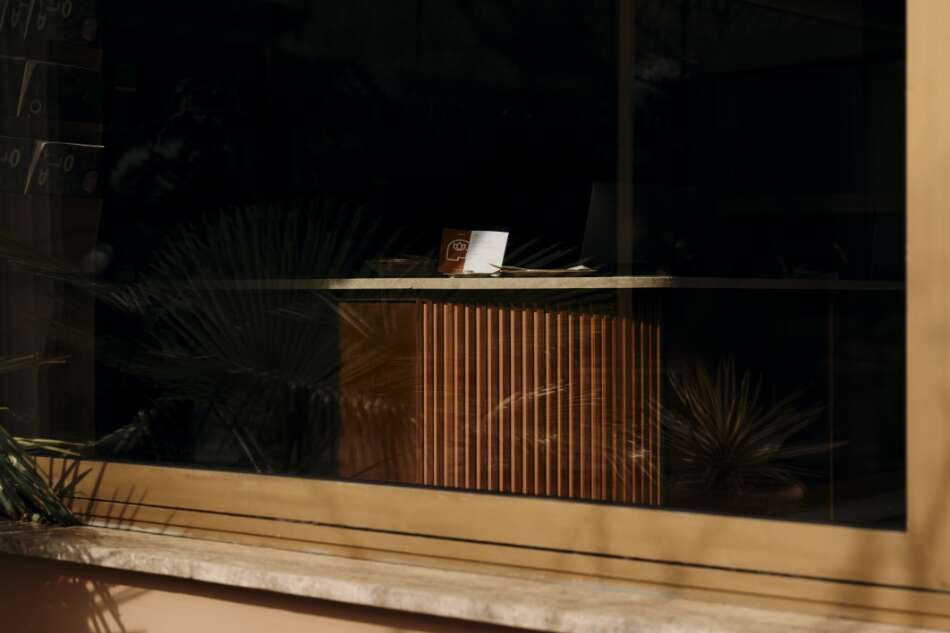
Set just behind the city, the hotel opens into an unexpected quiet. A private park filters the light, shifting the pace almost instantly. Inside, history defines the space—high ceilings, generous volumes—while materials and colours are used with precision. Muted tones, tactile surfaces, clean geometries. Wood, stone and fabric absorb the light, building depth. The same language extends outdoors: green tiles, terracotta, dense vegetation. Everything feels composed.
Within this setting, objects enter naturally into use. Menus open, bottles pass from hand to table, materials evolve through contact. Design shifts with time, shaped by use.
Every object is part of a wider composition. On the bedside table: metal, paper, glass. Keys left at the end of the day, an open book, a glass catching the light. In the wardrobe, wood meets fabric. Hangers hold garments in line, shoulder to shoulder, in a clear order. Materials relate to one another: matte surfaces, natural fibres, details that absorb light. Tones remain low, built on subtle variations.
Light settles on the volumes, defining them. This is how the room takes shape.
.
Every interaction unfolds with clarity. The menu rests comfortably in the hand, pages turning with ease. Bottles move with a steady, fluid gesture. In the wardrobe, the hanger supports each garment, maintaining form and order. Weight, proportion and material guide each movement. Gestures repeat, rhythm settles, and the experience becomes continuous.
What remains is alignment: between use, form and movement.

Luis Zuegg Str. 40, I-39100 Bozen (BZ)
+39 0471 637524 | fon
+39 0471 637678 | fax
info@prima.bz
© PRIMA GmbH - Imprint - Terms and conditions


![[Translate to EN:] Facebook Prima Hotelaustattung](/fileadmin/img/socials/001_facebookicon.png)
![[Translate to EN:] Instagram Prima Hotelaustattung](/fileadmin/_processed_/2/1/csm_002_instagramicon_1deb3c4d74.png)
![[Translate to EN:] Pinterest Prima Hotelausstattung](/fileadmin/img/socials/001_pinteresticon.png)
![[Translate to EN:] Linkedin Prima Hotelausstattung](/fileadmin/img/newIcons/linkedinicon.svg)


